Lisbon

Understanding life in Largo do Calvário - Lx Factory
Why people choose to live here
This corner of Alcântara stretches from Largo do Calvário down to the river, taking in LX Factory, Rua 1º de Maio and the Doca de Santo Amaro beneath the 25 de Abril Bridge. You get a real working neighbourhood, with old grocers, cafés and a municipal market, next to one of Lisbon's busiest creative hubs. The streets are mostly flat, which is rare in Lisbon, so daily errands are easy on foot. Designers, remote workers and young couples choose it for its mix of local life, creative energy and riverside space.
History and architectural character of Largo do Calvário - Lx Factory
Alcântara grew in the 19th century as Lisbon's industrial district, with factories, warehouses and workers' housing along the valley. Largo do Calvário takes its name from the former Convento do Monte Calvário. LX Factory occupies the complex built in 1846 for the Companhia de Fiação e Tecidos Lisbonense, a textile mill later used by printing works, and reopened as a creative hub in 2008. Low brick sheds, iron frames and painted facades sit beside tiled apartment buildings. Since 1966 the 25 de Abril Bridge has crossed overhead, and it now defines the skyline of the neighbourhood.
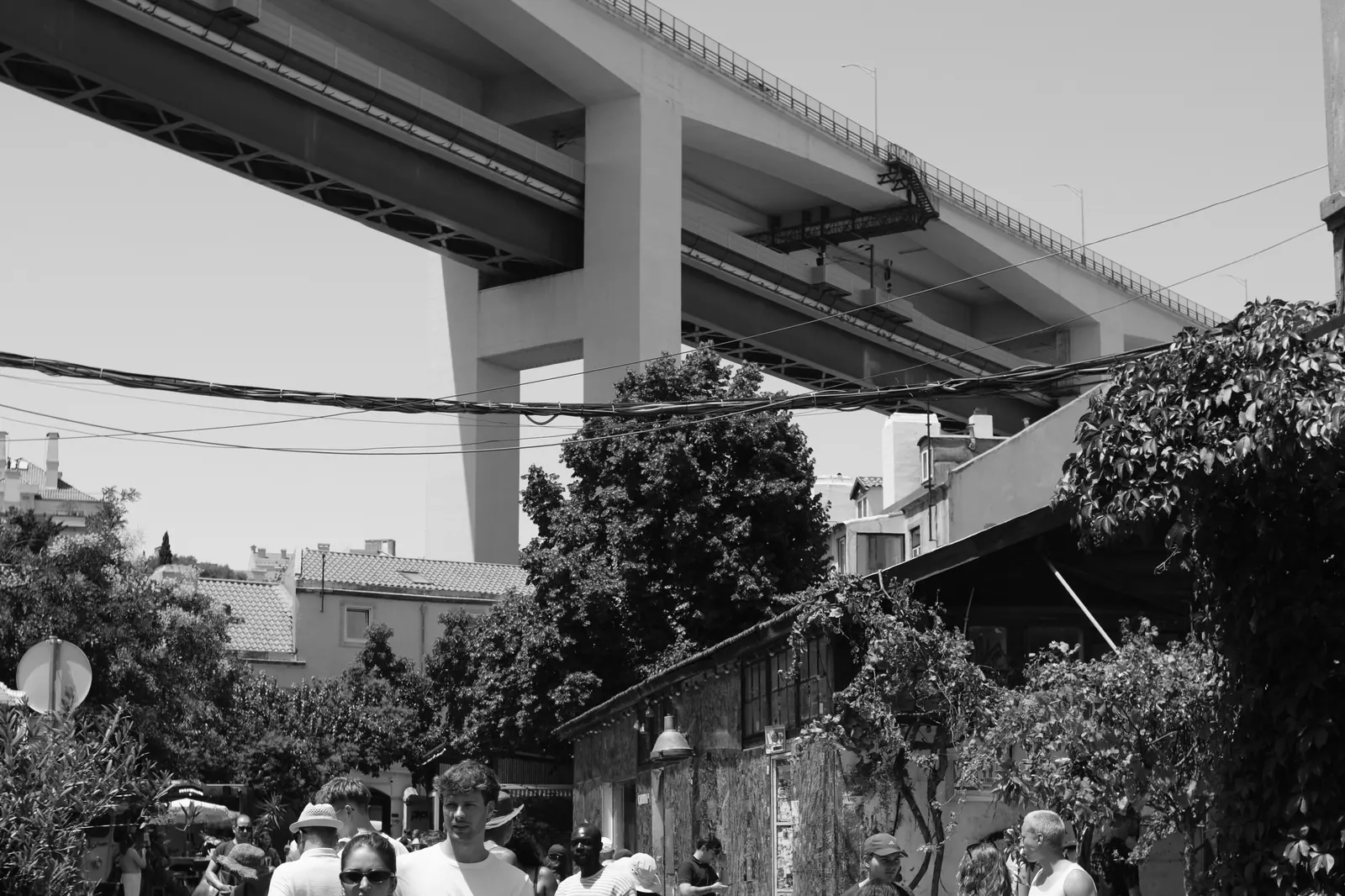
Daily life in Largo do Calvário - Lx Factory
Shopping and local services
Everyday shopping is close to home. The Mercado Rosa Agulhas, the municipal market on Rua dos Lusíadas, sells fish, fruit, vegetables and meat from Monday to Saturday, 7 am to 3 pm. Rua 1º de Maio and the streets around Largo do Calvário keep traditional grocers, bakeries, butchers, pharmacies and hardware shops, alongside supermarkets for the weekly shop. LX Factory adds bookshops, concept stores and design studios rather than daily essentials. Banks, a post office and the services of the Junta de Freguesia de Alcântara, the parish council, are all within a short walk.
Education and family life
Families rely on the public schools of the Manuel da Maia and Francisco de Arruda school groups, which cover nursery, primary and lower secondary levels across Alcântara. The Escola Secundária Fonseca Benevides, on Rua Jau, takes older pupils up the hill. Public places follow your address, so registering at the parish level matters. For international education, the Cascais train line from Alcântara-Mar reaches St. Julian's School in Carcavelos. The Mercado Rosa Agulhas has a covered play area, there is a playground on Rua 1º de Maio, and the riverside promenade gives children space to cycle.
Health and medical services
Primary care is handled locally by the USF de Alcântara, the public family health unit at Rua 1º de Maio 93, where residents register with a family doctor under the national health service (SNS). Pharmacies are spread along Rua 1º de Maio and around Largo do Calvário. Hospital CUF Tejo, one of Lisbon's main private hospitals, stands just east on Avenida 24 de Julho, a short walk away. The public Hospital de Egas Moniz, on Rua da Junqueira, is also close. Many foreign residents combine SNS registration with private health insurance for faster appointments.
Transportation and connectivity
There is no metro station yet: the extension of the red line to Alcântara is planned for around 2030. Trams do the job instead. The 15E, running west to Belém and Algés, and the 18E, climbing to Ajuda, both stop at Calvário and link you to the city centre. Just east, Alcântara-Mar station on the Cascais line reaches Cais do Sodré in a few minutes and the beaches of Oeiras and Cascais, while Alcântara-Terra serves the Azambuja line. A flat riverside cycle path runs from Cais do Sodré to Belém, and the bridge leads to the south bank.

Leisure, culture, and social life
Parks and green spaces
Green space here is mostly about the river. The riverside promenade along the Doca de Santo Amaro and Doca de Alcântara is where residents walk, run and cycle, with open views of the 25 de Abril Bridge and the Tagus. The same path continues west to Belém. Up the slope, the Jardim Avelar Brotero offers shade and a playground, and the Tapada das Necessidades, a former royal park just east of the valley, is a quiet place for long walks. Weekend outings often extend to the Tapada da Ajuda, a large wooded park higher up in Alcântara.
Restaurants, cafés, and nightlife
LX Factory and the docks set the tone in the evening. Inside LX Factory, Cantina LX serves Portuguese dishes in the former workers' canteen, A Praça mixes petiscos and pasta, and Landeau is known for its chocolate cake. Along the Doca de Santo Amaro, converted warehouses such as Doca 6 and Tráfico have terraces facing the marina and the bridge. Village Underground, next to the Carris tram depot, adds a casual café in shipping containers. The atmosphere is relaxed and mixed, busier on weekends, and the well lit docks and main streets feel safe at night.
Culture and local events
Culture is built into the old industrial buildings. Ler Devagar, inside a former printing works at LX Factory since 2009, is one of Lisbon's best known bookshops, with talks and concerts. LX Factory also hosts exhibitions, street art and design events throughout the year. Village Underground Lisboa, made from 14 shipping containers and two old Carris buses, runs concerts and creative workshops. The Museu da Carris, at the Santo Amaro depot, tells the story of Lisbon's trams and buses. Just east, the Museu do Oriente covers Portugal's links with Asia, and the June Santos Populares bring street parties.

Ready to make this neighborhood home? Explore our fully furnished apartments, designed for living, not just staying, and move in with nothing but your suitcase.

Unique and varied interior designs to match your style
Our friendly team is here to help. And if you prefer write us to hello@ukio.com
MESSAGE US ON WHATSAPP
LET US KNOW YOUR PREFERENCES